Deeper Dives
Some people don’t like water. I know that, but I do not understand it, because I am not one of those people. I love water and have since I was a kid. I love swimming in it, paddling across it, jumping into it. I love watching the ripple of currents or the surge of the tides. I love putting my feet in streams. I love lounging next to pools. Water and I are friends.
It seems logical, therefore, that someone who likes being in the water as much as I do would enjoy scuba diving.
Spoiler: not so much.
Logic has its limits.
I’d been kicking the idea of scuba certification around for awhile, and when Peter stumbled and I across a class being offered, we immediately signed up. I entered the pool that night with a mix of excitement and nerves.
We were tucked away on a subterranean floor of a community rec center, in a windowless room where the air smelled of chlorine and every clanging pipe in the building seemed to echo. Human voices had a lot to contend with, and I struggled to hear the instructors. Not to mention, the vocabulary of scuba is unique. Regulators. BCDs. Words that were as unfamiliar to me as a foreign language (or an explanation of benefits from my health insurance.) Basically, taking scuba classes at an indoor underground pool is like listening to a lecture of which only 50% was English while your head is wrapped in a wet pillow – and you’re treading water. It made me grumpy.
Secondly, scuba requires a lot of stuff. Weight belts, the aforementioned BCDs* and regulators, tanks, masks, snorkels, fins. Wetsuits. I’m a minimalist when it comes to sports equipment, which makes lap swimming ideal. It requires a bathing suit, goggles, maybe a swim cap. That’s it. That’s the way I like it.
Not so with scuba. And with diving, it’s not just the amount of equipment, it’s the energy needed to use it. Moving the stuff is exhausting. Putting it on is exhausting. Rinsing it and putting it away is exhausting. Plus, the techniques for moving underwater in scuba gear required unlearning habits that had become second nature from decades of swimming unencumbered. Instead of strokes, I wasn’t supposed to use my arms. I had to put appendages on my feet, and rather than timing my breath and forward motion as I did on the surface, I sucked oxygen through a device. I wondered how many other peoples’ mouths my regulator had been in.
Bottom line: it was too much. Too much noise, too much stuff, too much to think about. My body has a natural tendency towards buoyancy, and would stubbornly insist on rising towards the surface despite the weight belt I donned and my efforts to stay submerged. I spent ridiculous amounts of time expelling air from my BCD and then reinflating it in what became a constant slow-motion, underwater game of yo-yo. Maintaining a consistent depth required relentless effort.
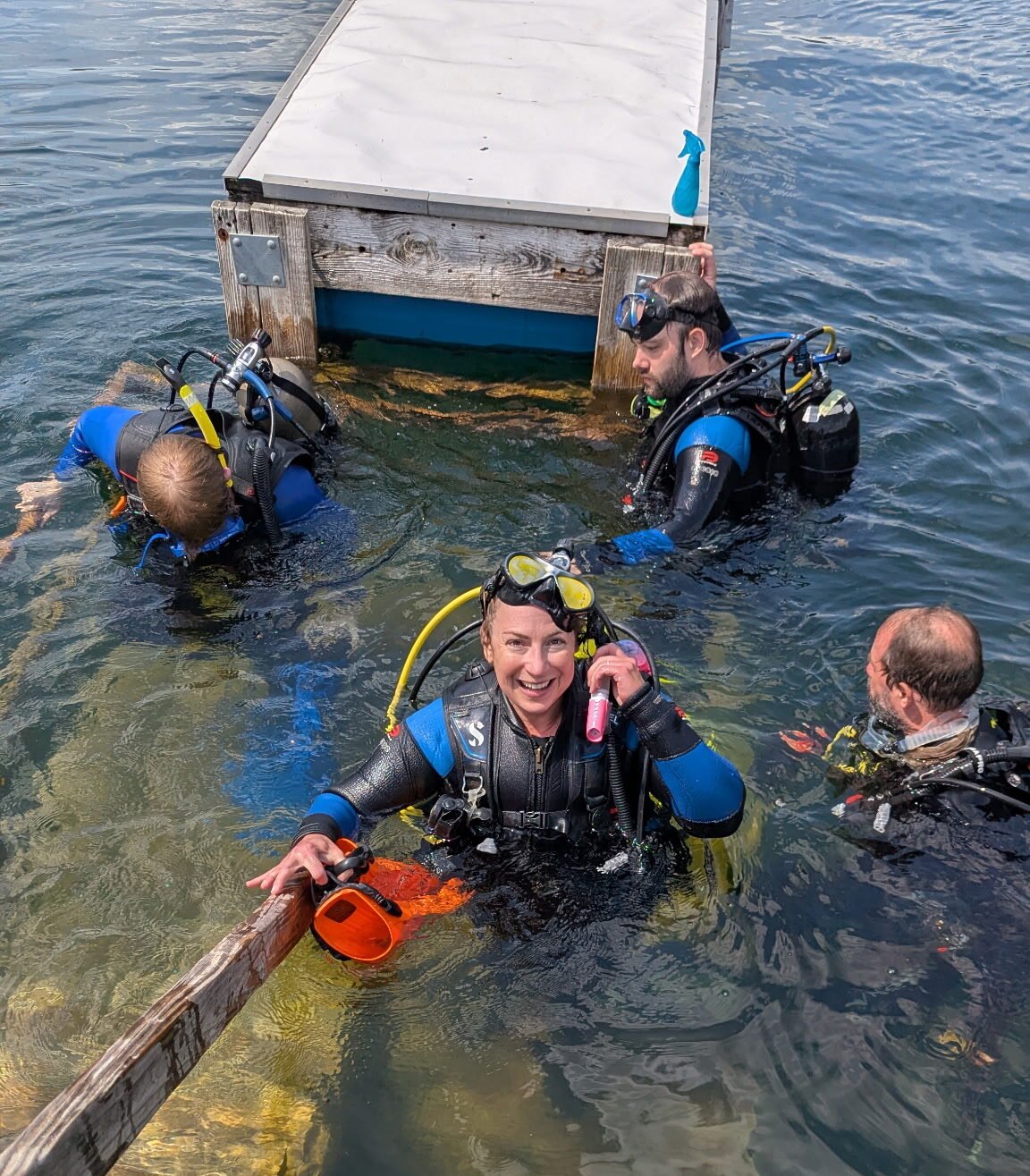
I never really relaxed in scuba class. It never became fun. The weeks of instruction and practice were something I endured rather than enjoyed. But endure I did.
Finally, the day came to complete our certification dives. For this we needed deeper water than what the pool offered, so we drove out to a former quarry on a hot Saturday in July. There, in the murky waters where visibility was minimal, we dove. And dove.
On land, my wetsuit felt suffocating. Once we descended and hit the quarry’s thermocline, it offered some insulation from the chill, but not enough. My regulator slipped out on a few occasions, so I ended up gulping mouthfuls of brown quarry water. The aquatic life consisted of mainly sunfish, who approached us fearlessly; the novelty of being that close to another creature underwater wasn’t lost on me. Still, my happiest moment in the quarry was when I emerged from it after my final dive.
I lurched ashore, thinking only that I’d soon be free of my wetsuit and the cumbersome gear. The day had left me tired and thirsty and hungry, not to mention wet. I couldn’t wait to make a beeline for the car and change.
A stranger approached. As she came closer, I saw that she held a container in her hands. She extended it towards me.
“I made banana bread. Please, take some. I remember being absolutely starving after I finished my dives.”
I could have hugged her. Instead, I simply took a proffered slice. Then I took another. The bread tasted sweet and toothsome and delicious. I could have eaten half of the loaf, but I didn’t. Still half-stunned by unexpected and generous gesture, I thanked her.
Maybe it was my fatigue, maybe it was my sheer relief to be out of the quarry, but I felt suddenly emotional. It wasn’t just banana bread this stranger had offered me. She’d offered the gift of unearned kindness. I felt the unexpected grace of being given something I’d done nothing to deserve.
I hobbled on towards the car. Yes, I’d finally completed my scuba certification. But what I took away from the day felt far more meaningful. When you are barely standing upright, when you least expect it, you just might be seen.
Unrequited
I love spring. I always have. I love the flowers, the sky, the sunshine. As a kid, I loved the arrival of tadpoles and ducklings. (Part of me still does). In England, I loved seeing adverts in the newspaper when it was lambing season and then seeing a frantic white cloud of baby sheep race from one end of a pasture to the other. Even city living didn’t quash my enthusiasm for all things spring; I simply had to look a little harder for it.
I love clearing away winter’s detritus from the garden and planting the season’s first vegetables. I love that ice has vanished from sidewalks and that I can walk – and sometimes run – without fear that a misstep will send me skidding. I even love the first one or two times I crawl on hands and knees pulling weeds, simply because it means that things are growing again.
I love spring even though it doesn’t love me back.
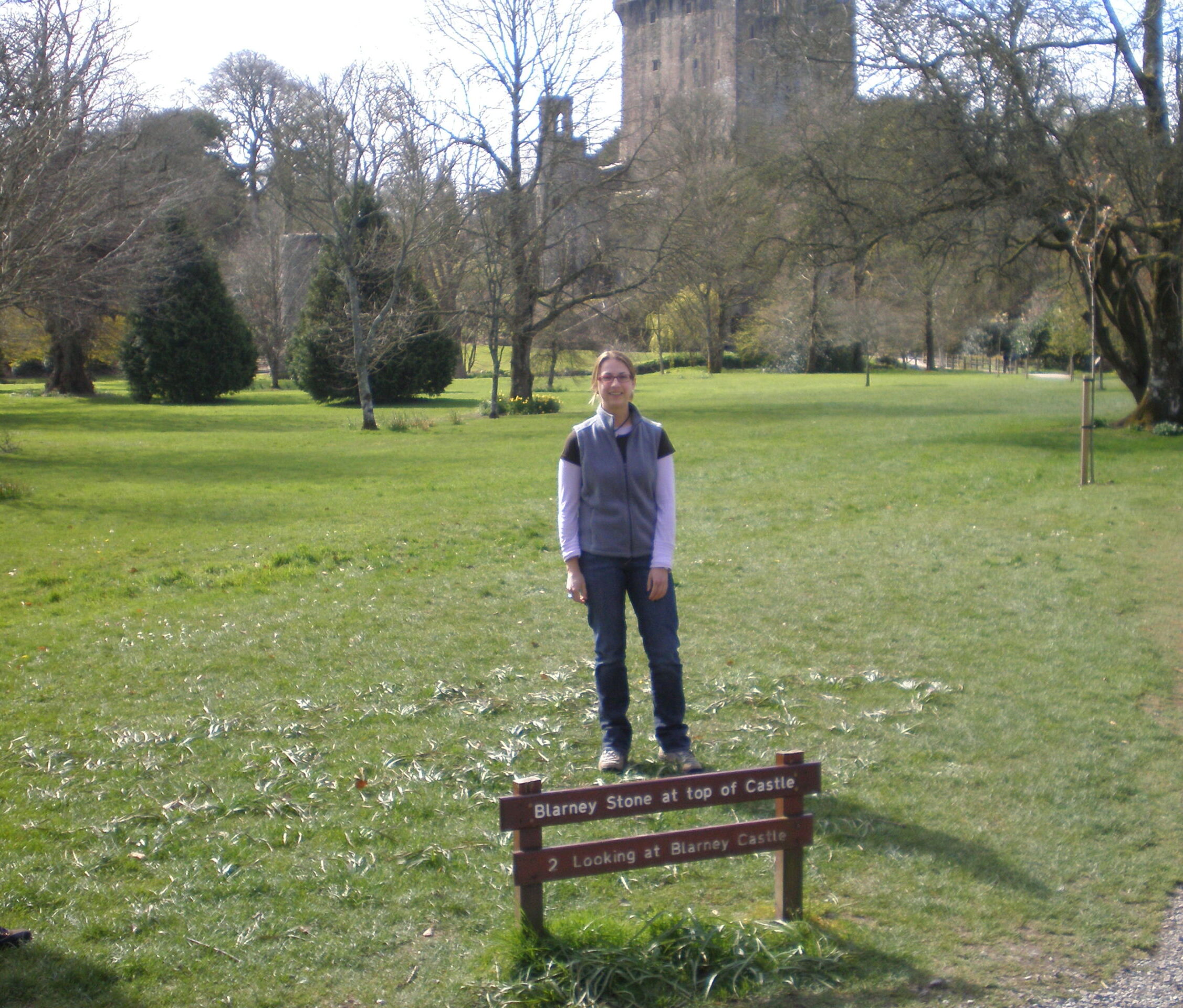
You might even call our dynamic acrimonious. In exchange for my decades of affection and appreciation, what spring gives me in return is simply cruel: seasonal allergies. My favorite time of year is the time when its hardest for me to be outside.
Take your pick of pollens: tree, grass, weed, mold. Basically, if there’s an airborne anything from a plant, my sinuses will detect it and go haywire.
Not that I let that stop me. I arm myself with antihistamines beginning in March. I keep neti pots, herbal teas, even the odd N95 mask at the ready. I look at spring through a window and calculate the pleasure of being outdoors against the physical discomfort that will likely result.
Despite the sneezing fits and ever-present tissues, I find myself drawn outside, eager to experience every moment that spring has to offer. Perhaps that’s the nature of love—it’s rarely perfect, and sometimes it’s even a little bit one-sided. If there’s anything that spring shows us, it’s that life moves in seasons. We need to take them as they come.
Vibes
New York City is more than a place. It’s a mood. It’s a state of being.
Or so it has seemed to me, from the first time I visited during a high school chorus field trip (imagine a few dozen teenagers belting “Seasons of Love” atop the Empire State Building, in the rain), to my most recent stop just last month. It’s a place where things happen, and I can’t help but be caught up in that energy.
Perhaps that is why I never stay long in New York. Seventy-two hours is about my max. Then my need for solitude – or at least, the absence of a crowd – becomes so acute as to become a craving. Walking in Central Park or across the Brooklyn Bridge sometimes helps. The exercise and being out-of-doors typically buys me a little time. I can drift among strangers, cloaked in anonymity, and lose myself in my thoughts.
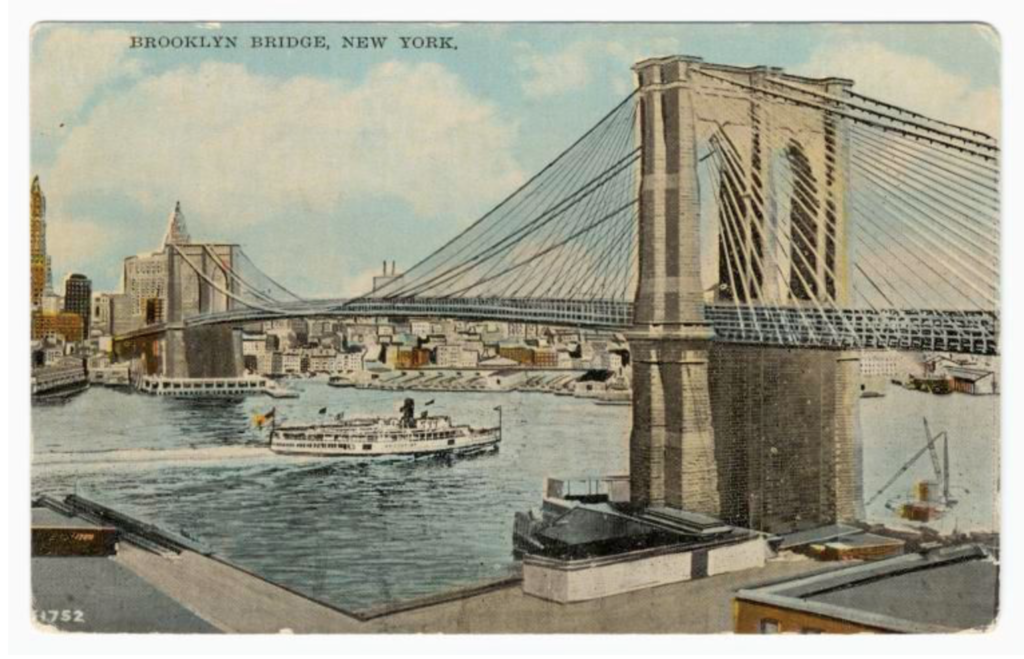
I did no such pensive walking on my last visit. It occurred in January, and the itinerary was decidedly indoorsy. ’d come to New York on a mission to see Keanu Reeves in Waiting for Godot. He was headlining a production at the Hudson Theater along with Alex Winter, and the opportunity to watch the stars of the Bill and Ted franchise in real, live, serious theater was one I couldn’t pass up.
I’ve been absolutely fascinated by Waiting for Godot for years. Decades, even. Admittedly, I’d never seen the show – I’d never even read the play – but I was well aware of its cachet as a touchstone for the theater of the absurd. The very first days of 2026 seemed as good a time as any to ante up.
And so Peter and I found ourselves queued up on sidewalks still covered with paper confetti from New Year’s Eve, waiting among the closing weekend crowds. Then we were in our seats, the house lights dimmed, and the curtain rose.
I realized my mistake immediately. In our haste to leave the hotel, I’d forgotten my glasses on the bedside table. I could see the stage, I could see the set, and I could make out the actors’ movements. But I could not see their faces. At least, I saw them only in a somewhat blurred, Impressionistic painting kind of way.
I squinted my way through the performance. By paying close attention to gestures and tone of voice, I followed what was going on. Not that there’s much of a plot in Waiting for Godot; that’s part of the point.
The irony of it struck me. Here I was, finally witnessing a piece of theater that had lived on my bucket list for years – in NYC, of all places. On closing weekend. With a celebrity cast. And I could not see the actors.
I like to think Samuel Beckett would have laughed. I did. Both at the situation, with all the ridiculous little tragedy folded into it, and at the play itself. Yes, it’s dark. It’s stark. Sometimes the language cascades into hopelessness, and the audience has no choice but to go right along with it.
And yet I could not say it was a sad play. Of all the emotions I witnessed on stage that night, fear was not among them. That fact whistled itself through my consciousness like a signal beacon. And with it, a whisper of hope.
I knew what it was to live with fear. And I knew what it was to live without it. I nodded, as if Samuel Beckett sat right beside me. I looked at the stage, smiling. I laughed again.
Out of the Woods
Contrary to its title, this post is actually about being in the woods. Not in the woods in the sense of being lost, or of going deep into the backcountry, hatchet and compass in hand. As wilderness visits go, this one proved rather tame: I slept indoors every night on a comfortable mattress, I ate meals prepared in restaurants, and my time spent in the woods consisted of daily afternoon hikes on well-marked trails.
Even so, it was a far cry from my every day. The woods sounded different, smelled different, felt different. I deliberately walked slowly. Back in the city, I spent too much of my life moving quickly. Here I allowed myself to sink into the stillness. I looked around me. I paused enough to notice things. I tried to pay attention to what was small.
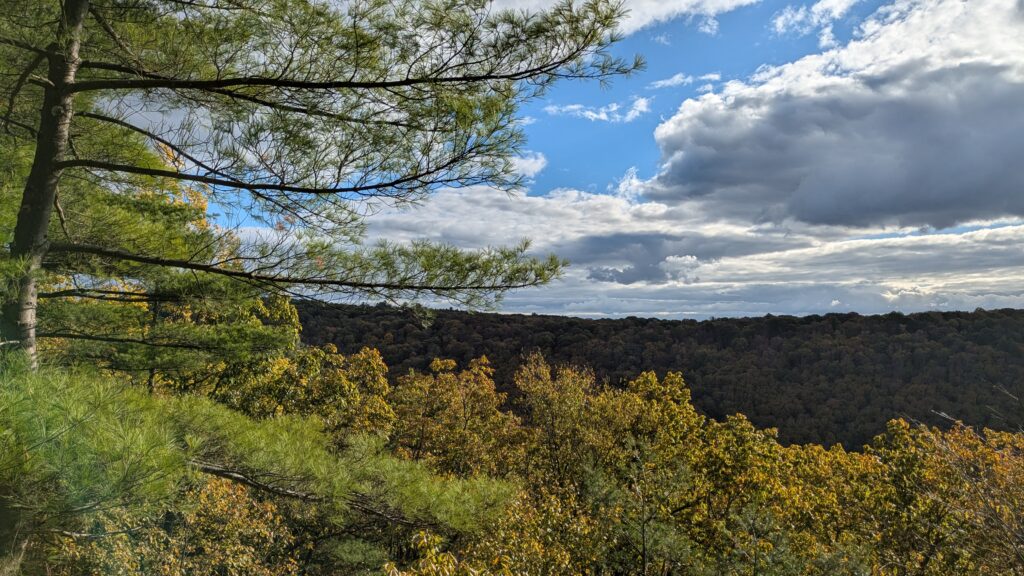
For example, the lichens, ranging from the palest grey-green to a color nearly as deep as emerald. The bright yellow of fern leaves. The way the sunlight hit the trunk of a hemlock, illuminating a sliver of the forest in transient brilliance.
I found myself surrounded by living things, yet it created the opposite sensation of feeling crowded. The trees afforded quiet company. We shared space, but nothing more. There was something soothing in their remoteness, a peace in being among creatures who asked me for nothing.
When I did encounter other hikers, I went out of my way to avoid them. Perhaps a part of me felt safer alone with the trees than I did in proximity to homo sapiens. Trees hold no ideologies.
The woods were quiet. At times, they felt almost unnaturally devoid of noise. If I listened, I could discern traffic or human voices in the distance. I heard an occasional call of a blue jay, or sometimes a chipmunk rustling among the leaves. Once I caught the sound of a crow’s feathers stirring the air as it flew overhead.
Most of these moments were mine alone, but I wasn’t always in solitude. One morning Peter and I sat on a large boulder next to the Clarion River. An angler walked along the opposite bank, speaking noisily with his companion, and we exchanged annoyed glances at the sound. Why did people with no sensitivity to nature insist on visiting it? Or perhaps the situation was simpler: humans are merely poor judges of the sound of our own voices.
I looked upstream. A bald eagle perched in one of the trees. As I watched, it lifted off from its branch and flew nearly directly overhead. I followed it with my eyes, breathless. I’d seen bald eagles in their natural habitats before, but never this close.
The situation I’d been lamenting only a moment before instantly transformed. I suddenly felt lucky to be exactly where I was. Sitting on a naked boulder, feeling the stone’s coldness leach through my clothes and its unyielding surface supporting me. But that didn’t matter: I was in the presence wild things. And I was glad, very glad, not to be “out of the woods.”
Snowflakes
I grew up in a place with long winters. Snow might fall as early as October or November. Of course, it didn’t stay: real snow didn’t come until December when the sun set in the afternoons and ice completely covered the lake. But I didn’t mind the cold. Winter meant sledding and snow angels and ice skating. I was giddy whenever there was fresh snowfall in the mornings, with a child’s excitement to see everything covered by a white blanket as if by magic.
Later, in junior high, winter activities grew slightly more adventurous. I took skiing lessons. Mind you, the mountain was small, the slopes manageable and the lodge’s specialty was deep-fried Oreos. There was no chair lift; a creaking T-bar pulled you to the top. I don’t recall anyone wearing helmets except a few snowboarders. It wasn’t unusual for a Carhartt to double as a ski jacket. But one has to start somewhere.
And I did. I learned how to fasten my boots and use the poles. I could execute cautious snowplow wedges as I descended the slopes. I progressed grom green circles to blue squares to black diamonds. Things gelled just as I left for college in Atlanta GA. Over the next several years my studies and career took me away from snowy places (although I did manage to get frostbite skiing with friends in Maryland.)

But it is strange how life comes full circle. Earlier this month, for the first time in more than two decades, I was back at the place I began. It was a beautiful February day. Bright sky. Mild temperatures. Sunshine. A friend and I made the two-hour drive from Pittsburgh, leaving highways behind for two-lane roads that cut through farmland.
I saw that things had changed since my last visit. There was a chair lift and an upgraded bunny hill. Wooden walkways, and an extended snowtube area. But mittens still hung around the enormous wood fireplace in the lodge. I even spotted a few Carhartts.
My first run was cautious. The second one was the same. I wasn’t a careless 17-year-old anymore, swooshing down the hill. Age plus past injuries¾ a torn ACL, motorcycle accident, sprained ankle, and hamstring tear¾ made my risk calculus much different from what it had been.
But each time the apprehension grew a little less, and the joy took hold a little more. The day was so beautiful it was impossible not to fall under its spell. My body remembered how to glide. How to let go. And for a couple hours on a magical afternoon, I did.
Footloose
The weather is breaking. Winter loosens its grip (not that this past winter was particularly cold) and more often, I venture outside by choice rather than necessity. I am reminded of the pleasures of unhurried walking. Of moving slowly, at street-level, without the distractions of a phone or vehicle.
In February, Peter and I traveled to Toronto. We traveled miles on foot in a snowy city, from our hotel in the Yorkville neighborhood to the CN Tower to the Art Gallery of Ontario and back. It is a distance of about nine miles, broken up by coffee and lunch and sightseeing.
The morning of the walk began quietly. Few people are outside, but gradually the number of pedestrians crescendos so that by nightfall, which comes early, the streets are bustling. Everyone is bundled up with hats and gloves; even some of the dogs wear coats.
At the top of the CN Tower, the views over Lake Erie are breathtaking. A small plane circles over Toronto Islands, descending, skimming the runway, and then lifting off again. I hear voices speaking in languages other than English, and I smile. This is my first international trip since the pandemic. It is strangely comforting to be back among the tourists.
Squads of families roam the galleries of the Art Gallery of Ontario (or AGO, as its more locally known). The noise creates a pleasant background ruckus as Peter and I spend an afternoon discovering Canadian artists that were completely new to us. In between gazing at the artwork, I take to looking at people looking at art. This always fascinates me: what they notice, what they pass by, and the differences between the way adults and children behave.
On our walks, Peter and I passed storefronts and academic buildings and lampposts covered in handbills. There was the pharmacy, brightly lit by the afternoon sun, with a technician’s white lab coat flung across a chair. On the university campus, printed flyers announced sexual health week, advertised tutors, and promoted a philosophy discussion group. In the digital age, where information travels instantly in bits and bytes, perhaps paper still matters.
These are little moments, little kernels of stories that exist in a flash. Kernels that might become something more if we let them.

Back in Pittsburgh, my home city, I start to see things I hadn’t noticed before, like the sign on the door of a Polish deli cautioning shoppers to “watch your dupa.”
Being outside of a car brings you into contact with things. With people. On the T one morning, I’m sitting next to a young mother with a squirming toddler on her lap. I offer her my seat, so she can have her little boy beside her, but she declines. He is fussing, and she is alternately chiding him and attempting to distract him by talking about what can be seen from the trolley’s window.
I think of everything that must be done to get a small child out of the house in the morning: the waking up, the feeding, the dressing, the finding of socks and shows. Brushing of hair and teeth. I want to tell her that she’s doing a great job. But I don’t; unsolicited commentary from a stranger, no matter how well-intentioned, could feel presumptuous.
On an afternoon a few days later, I’m walking the streets near my office, which happens to be near the location of a Planned Parenthood clinic. There is a small group of protestors clustered outside. I see the signs and flyers and want to tell them that Planned Parenthood focuses far more on pregnancy prevention than pregnancy termination. I want to say that they have it twisted, that this is a health clinic and not an abortion factory. I want to say that they should consider finding something else to do instead of hassling a woman trying to get a friggin’ PAP smear on her lunch break.
Confrontation is not compassion, and brochures and Bible verses are not what’s needed. But I don’t say anything, and I walk on.
I think of the age of the city, of the footsteps of those who walked here before me. The natives and the explorers and the soldiers. I think of the people around me now, of the space we share and the slices of time where, just for a moment, we might glimpse a world outside of ourselves.
And I walk on.
Anchoring, Part 2
I am sitting in the main branch of the Erie County Library. I can’t remember the last time I sat in a library, in person, with a stack of notebooks and my laptop computer. It feels wonderful. The quiet is exquisite. But this room is not silent – there is the distant hum of a machine, the rustling of papers at the reference desk, the tap of my keyboard.
Earlier I chatted with friendly, elderly German at the gift shop. We started talking about a German comedy show (Last Man Laughing), then humor in general, then spoofs on 1970s variety shows. From there the conversation moved to HEMA, world politics, WWII. We discussed the lack of pens for sale in the gift shop (he loans me one). I ask about the German word for cheesy. He thinks for a moment, then answers “kitschy.” Yes, English uses kitschy too – or more accurately, absorbed it from the German.
You might say I’m on vacation, of sorts. It is the first week of May, the coldest I can remember in decades. There is rain. Temperatures are nominally above freezing. Wind and gray skies. Snow flurries.
But I want to go outside, and so I do. A short, frigid run from the lakeshore cabin where I’m staying to the main street of my hometown. Past the tiny beach, with the sign indicating that no lifeguard is on duty. Past the old cemetery with 19th-century graves and their old-fashioned names carved into the stone. One of the markers, I remember, bears the words, “Killed at Gettysburg.” I run past the trees with new leaves, over a scattering of pink dogwood blossoms lying on the damp sidewalk. I dodge puddles on the pavement.
In times of transition, I return here. To my roots, as much as I have any. I return to incubate myself in the familiar.
On another afternoon I walk along Lake Erie, the wind blowing my hair in crazed directions, the waves roaring as if I am at the ocean. No one else is on the beach, aside from a single pedestrian with a dog, off in the distance. I turn away, walk so that I can face the breakwaters and tide, look at the water hissing out over the sand as it is drawn again into the lake. I am in solitude, I am alive, and the moment is mine alone.
I think of how rooms of books light something in me. Smells of spring light something in me: the rain, the leaves, the soil, the blossoms. Being next to water and tides lights something in me. Despite the cold, I run May-mad.
A day’s agenda might look something like this:
Coffee, early.
Back to bed.
Journal.
Go outside.
Eat. Watch a loon swim. Allow myself to be surprised. Allow myself to be unproductive.
I read an article on social media and banking risk, then another on the US Constitution and presidential pardons. I browse Pinterest. I am both exhilarated and quiet.
In the sense of linear trajectory, I’ve come to a stop. I’m in between jobs, having been let go after the end of a lengthy contract. And for Americans, being out of a job is synonymous with being without purpose. Without value.
But I cannot believe that this interval of time, these days, are wasted. I am simply paying attention to other things.
From my cabin I have an excellent view of wildlife. Herons, a pair of eagles, loons, geese, goldfinches. A muskrat that popped from the lake early one morning to chew vegetation along the water’s edge. I smile at all of them, glad to be back among wild things, glad even, in a way, for the wild weather: it makes the roof, the heat, the warm bed all the more precious.
If there is a lesson anywhere, it is this: I am learning how to live in the in-between spaces. I fall to pieces. I fall into peaces. Slowly, I let myself fall into place.
Sprung
There comes a point in every woman’s life when she has simply had enough. When a yoga session or a shot of whiskey (or kombucha) or ugly crying while listening to Adele simply won’t cut it. When griping to friends, or a therapist, can no longer suffice. When the situation requires stronger, more drastic, more radical measures. Measures that some might say are selfish. Measures that might not be life-changing, but certainly bend it, make it less rigid.

I reached that point earlier this month.
But before I proceed to describe my mid-life Spring Break, I acknowledge that I am damn lucky, and privileged, to have even had the option. It was with excitement and guilt and second-guessing that I bought my ticket, booked my hotel, stepped onto an airplane.
Yet I knew, in my bones, that it was time. It had been, after all, two plus years of living alone, working from home, cooking and eating hundreds of meals in solitude. At times I reveled in the silence; at other moments, I felt profoundly isolated.
There was being laid off, and then working two jobs, and then worrying if I needed to start panic buying toilet paper and canned goods.
There was the death of my grandmother from COVID-19.
There is near-endless uncertainty.
And there is my dog, my sweet, lovable, wonderful dog, who has chronic medical issues that require both regular visits to a veterinary dermatologist and an array of treatments that makes my head spin.
I needed out. Just for a little while. But I most certainly needed out.
My destination: Miami. Hot, sunny, Spanish-speaking Miami. Miami, of sandy beaches and spring breakers. (One of my Uber drivers, God bless him, actually asked if I was on spring break. Yes, I look younger than I am, but not that young…so either my mask hides a lot, or he really needed a good tip.)
My plan: Do as little as possible. I’d never visited Miami Beach before and had few preconceived notions of what to expect, beyond palm trees and heat. (I was not disappointed in either).
My outbound flights took me through New York, via JFK. It was a cold but gloriously sunny day, and as the plane began its descent, all of New York Harbor, with its ships and patches of ice floating in the waves, was visible from the plane window. I almost started to weep. The sense of openness, of possibility, of freedom was overwhelming. I was moving again. And a part of my soul that I’d been missing came winging back.


Touching down in Miami several hours later, night had fallen. I stared out of the cab’s window like a country bumpkin as I was driven from the airport. Air conditioning in March was a novelty to me, as was the city lights, the water, the boats, the neon illumination. I drank it all in.
And I accomplished what I’d set out to do.
I spent hours in the sun, either poolside or at the beach. The ocean, which I had not seen in years, looked sublimely beautiful. Its colors, the light, the breeze all forms of magic. I felt the salt water on my skin, let the waves lift and carry me as I faced the sky and felt wonderfully, madly, happy.
I wasn’t entirely still, of course. I walked. A lot. From the Lincoln Road Mall to the Miami Botanical Gardens to the bougie juice bar where I paid $10 for some cold-pressed concoction of superfoods. One morning I biked the entire length of Ocean Drive. I visited Little Havana, bought cigars, drank rich and wonderful Cuban coffee and ate a guava pastry and spent the rest of the day practically high from the mix of caffeine and sugar.
And the heat. I’d left gray skies and freezing temperatures behind me. Light and warmth was what I wanted. And so I let my toes and legs and shoulders go bare, only to find that my skin could tolerate frustratingly small doses of the sunshine. Too much overwhelmed even my SPF-loaded lotions and I had to retreat indoors or under shade.
Yet there was, as is always hoped for with vacations, a blessed release from obligations. I took this a step further and seized upon what felt like a revolutionary level of autonomy. I answered to no one. There was no other party with whom to coordinate plans, discuss dinner options, or agree upon an itinerary. I ate when I wanted, slept when I wanted, woke when I wanted. It was the best thing I could have done for myself.
I was not alone in this. I saw other solo women: sunbathing at the beach, having appetizers and wine on the terrace, going about their days. I shared smiles with some of them. Because this is our world, too. And we had decided, singly and boldly, to put our feet down.
Postscript:
I remained fully aware of global events transpiring during, and after, my travels. I’ve proudly given support to the Ukrainian Red Cross, Doctors Without Borders, Come Back Alive, and other humanitarian organizations.
The Kyiv Independent provides English-language coverage of events in Ukraine.
You can also view amazing art from Ukrainian artists and illustrators showing their perspectives on events in their country.
American Abroad, Part 2
40 on the French Riviera

“On Thursday I’m going to the French Riviera.”
There was only one time in my life when I could speak those words. It was last month, when my husband and I were in Paris and about to begin part deux of our French adventure.
I’d booked us tickets on the TGV from Paris all the way to France’s Mediterranean coast. It was a rail journey of about six hours. And at the end of it would be Nice, gateway city to the famous French Riviera.
The objective in going? Simply to say that we, too, could trod in the same footsteps as 90% of the world’s superyacht fleet.
I had a free hotel night I could use in nearby St-Laurent-du-Var. With a quick internet search I found a seafront hotel with a private beach that happened to have availability. And voila! We were on our way.
But it wasn’t quite that simple. I was going to be turning 40. Along with that was the acknowledgement that, in all probability, I would never have biological children of my own. Would never be pregnant. Would never watch a life I’d created live and grow and learn. (And before you say, there are doctors and treatments and therapies…been there. Done that.) So I was on the French Riviera to let go of a dream.
Even saying the words “French Riviera” felt a little surreal. Stumbling off the train and into blinding sunlight and temperatures near 90 degrees F only added to the sense of having left Paris and landed in a strange, parallel universe.
Our first order of business was to get to the hotel. My husband found an Uber and as the driver sped us along the Promenade des Anglais, she spoke to me in indulgent French as we chatted about Nice’s remarkable climate and history. She even offered a few restaurant suggestions for our stay.
As soon as we’d checked in, I changed and made for the beach. No matter that it was nearly suppertime and the sand was nearly deserted. I’d come to experience the Cote d’Azur, and something as trivial as being hungry wasn’t going to stop me. I bobbed in the blue waves, momentarily sated, as the warm waters of the Mediterranean wrapped and held me.
The following day was Friday, September 13. My 40th birthday. I was up early enough to watch pink rays of light illuminate the sky above the ocean. We had breakfast on the balcony. Always terrible at loafing, even while on vacation, I set out soon after to explore the neighboring area. In short order I found a sprawling shopping complex, where I purchased gold hoop earrings, a colorful headscarf, white sleeveless blouse, and aviator-style sunglasses. I figured it was time to have a little fun.

Newly accessorized, I cajoled my husband into biking along Le Promenade. It was midday, which meant that it was blistering hot as well as beautiful. We grabbed lunch in town (a 3 euro slice of pizza for me, Chinese takeout for him) and biked back. That afternoon I returned to the beach in a swimsuit I’d snagged off a Target clearance rack prior to the trip. I may not have arrived on a superyacht, but dammit, I was doing it. I was in character.
Our idyll continued that evening for drinks at Le Plongeur, a beautiful multi-level seaside restaurant with views like something out of a James Bond film. We had dinner at the neighboring La Reserve – an exquisite meal of broiled fish served alongside bread, pasta, and olives, accompanied by excellent wine. For dessert the waiter presented a towering chocolate creation nearly too lovely to eat.
There was the tour via electric bicycles to a local vineyward. Vince cracked jokes with friendly Irish couples as we ate our sandwiches at tables beneath the olive trees. It was the first day of the grape harvest. Later we shopped at a local market where I found a pair of yellow earrings as bright as the sun.
All in all, I was able to live in a kind of magic for which I will be forever grateful.
Part of me – the part that dreamed of creating a child – was empty. It is a painful goodbye which is still ongoing. But another part, the writer and adventurer, came home very full.
Not every day can bring a trip to France, of course. But every day is a chance to give a gift to yourself. What will yours be? A shared laugh with a friend? A visit to somewhere new? A cup of your favorite coffee?
On one of my last days in France I purchased a small postcard that read, in gold letters, “Tout commence par un reve.” Everything begins with a dream. Many dreams don’t come true. But sometimes, we may embrace others that come to take their place.
American Abroad, Part 1

For years, Paris has lived on my bucket list. Decades, actually – ever since my first high school French class, when the very first French sentence I spoke was Paris est la capital de la France. Uttering those words felt very foreign. Very exciting. Very adventurous. And at last, two university degrees, nine job changes, a marriage, and three relocations later, I was going to go to Paris.
My husband and I touched down at Charles de Gaul airport on a sunny September morning. Despite our jetlag, with the help of Google and my high school French we navigated the local train service and then the subway, suitcases in tow, to emerge triumphantly from the Tour-Maubourg metro station in the 7th arrondisement. My first sight of Paris was a beautiful building facade, its windows shining in the midday sun. To my left was a bubbling fountain, and beyond that, a small shaded park. And in that moment, instantly and totally, I was in love.
Before we go further, to avoid disappointment if the following aren’t mentioned, let me disclose what I didn’t do:
- Tour the Louvre
- Shop the Champs-Elysees
- Visit the Moulin Rouge (or anywhere else in Montmartre)
- Wear a beret
Hardly anyone wears a beret in Paris. And of those who did, I suspect they were mainly tourists.
Having lived in Washington DC, a city that attracts its own fair share of visitors, I know that sightseeing often creates photo opportunities but not a true sense of place. I did concede to taking an open-top Big Bus tour, and happily grabbed shots of Notre Dame, the Paris Opera, and various monuments. But I also insisted that we hop off to walk in the Tuileries Gardens, and to visit the art and booksellers with their stalls along the Left Bank of the Seine. And we did join the crowds who flock to Versailles.
From its golden gates to the sprawling palace with its famed Hall of Mirrors to acres of artificial lakes, fountains, and formal gardens, Versailles is built to astound. And it does. But not even that power and splendor could prevent Louis XVI, and his Austrian-born wife Marie Antoinette, from meeting the blade of the guillotine.
I could not see Versailles without thinking of the bloodshed of French Revolution. I could not look at Notre Dame without remembering the terrible acts of religious violence that have marked Paris. Even the Eiffel Tower is not immune – today its lights sparkle in the Paris night, but during the German occupation of Paris in World War II, daring residents cut the elevator cables so that Adolf Hitler would be unable to get to the top of the monument unless he climbed it. (So far as we know, he never did.)
For Paris is a city that shows the magnificence of humanity, but also our cruelty. I did not want to be a careless visitor, one who saw only Paris’ beauty and forgot what suffering had occurred among its boulevards and parks.
So what did I do in Paris? I walked. I ate in bistros and cafes – lots of them. My husband and I strolled along the banks of the Seine at night and watched as the city lights reflected in its dark waters. We sought out the spot where medieval pilgrims left Paris to begin the long journey to the shrine of Santiago de Compostela. I indulged in all sorts of carbs: crepes, croissants, wine. I visited a bookstore and purchased the Paris Snob Guide, 1967 edition.

I even spoke a little French. It was uncanny to be able to understand much more of a a language than I could express. I listened to waiters or department store staff or radio DJs, and I had a sense of the conversation. But I didn’t have the spoken fluency to be able to answer. Sometimes the Parisians defaulted to English. Sometimes there was pantomime. Sometimes we had a hybrid conversation that switched between languages. My best French moment was probably a request to the concierge for a new hairdryer. We did it entirely in French, even the bit where he explained to me that the room key needed to be inserted in the slot for the light switch. And I responded, in French, that yes, we did that, and no, the hairdryer didn’t work and hadn’t worked since we checked in. He kindly found me another one.
And I watched Parisians. The daring motorcyclists and scooter riders zipping through traffic. A dad and his toddler son at the cafe opposite ours one evening. The man calmly smoked with the baby in his stroller beside the table. When the child grew restless, dad lifted him out and set him on a chair, and continued with his cigarette. The businessman in a park who, having finished his lunch, took off his suit jacket and laid it on the grass. He then lay back and rested for the remainder of his lunch hour. At its conclusion, he picked up his jacket, shook it off, and returned to work.
One of my favorite things about travel is the chance to see people in other parts of the world living their lives. And, perhaps, to step into an alternate version of my own.
The version where I wake to new foods, new sounds, new things to see.
And perhaps, just perhaps, I stepped closer not only to the person I aspire to be, but to a more authentic version of myself. The self that watches. The self that writes. On the morning of our last day there, I was up early. I opened the windows so that I could sit on the bed and gaze out at the cathedral opposite. It holds the tomb of Napoleon Bonaparte. Six stories below, Parisians moved toward the city center on their morning commute. I opened my journal, picked up a pen, and knew that I was exactly where I was supposed to be.
Next Month: American Abroad, Part 2, with adventures on the French Riviera.