Recently, during a conversation that touched on passion projects, a friend asked me what I get out of writing. She was referring to my creative writing, specifically – the kind I usually don’t get paid for, and which rarely reaches an audience beyond my friends and family.
It’s a fair question. I understood her inquiry came from a place of curiosity, not judgment. It contained no implication that I was wasting my time (which Americans have precious little of), or that I could be doing something more productive.
I paused for a beat, hoping to come up with a brilliantly eloquent answer. I ended up giving her an honest one.
“Because it’s a space I can control,” I said.
I hurried to explain, lest she think me some kind of authoritarian kook.
“It’s a space that can be anything I want it to be. I can escape there, I can create whole worlds if I want to. I call the shots on what happens and what doesn’t. There’s something very comforting in that.”
I thought of the storybooks I made as a kid out of pieces of construction paper stapled together, the awkward penciled text and childish illustrations done with crayons. I thought of college when I read Virginia Woolf’s A Room of One’s Own for the first time. I thought of the Covid-19 pandemic and how I wrote my way through first a divorce and then through a layoff. I thought of the writers’ group I’d stumbled into in Pittsburgh, and how important those Saturday mornings were for letting my brain breathe. Or rest. Or turn cartwheels, if the mood struck.
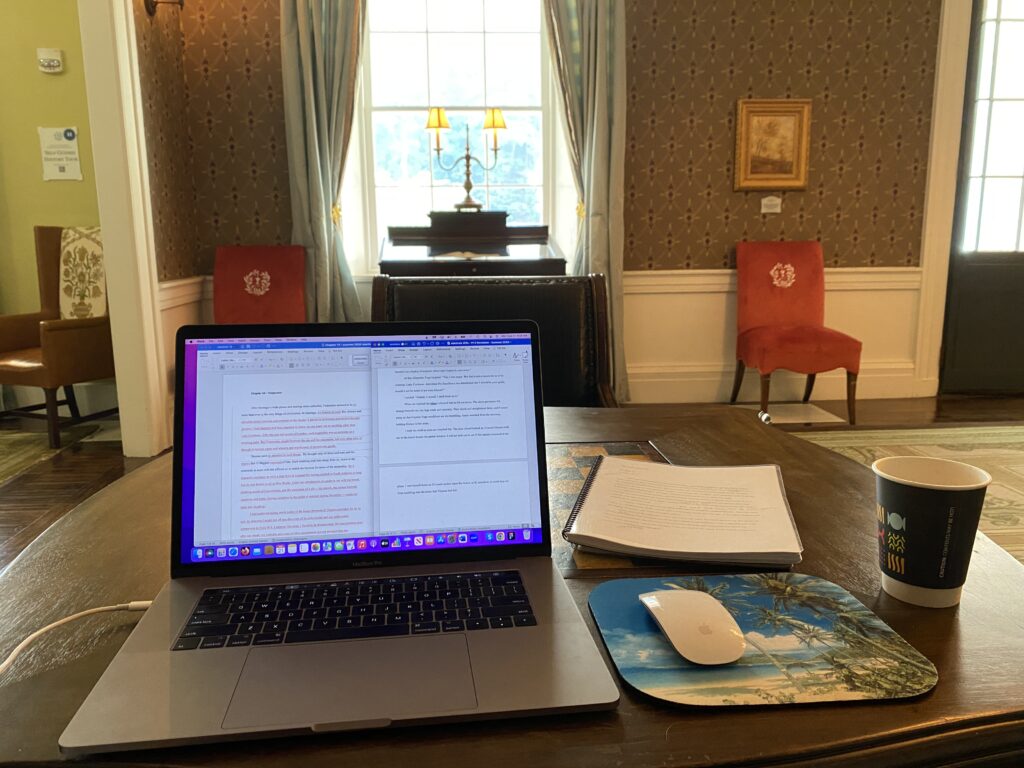
I don’t write because I like to write. I write because I have to write. It’s how I make sense of the world – or at least, find a way to laugh at it or cope with it. It’s where I make space for myself to live. And sometimes, sometimes, I crack the door open and invite others to step inside.