When two Type-A personalities get together, their idea of “relaxing” can often take the form of a side quest. In Peter and I’s case, soon after we began dating, we created several lists of films to watch together. Each list centered on a different theme; some of the themes were admittedly more creative than others. These included:
- The Pittsburgh List. Movies set or filmed in Pittsburgh. Ex: Striking Distance, Flashdance, Adventureland, etc.
- Classic Film List. Cat on a Hot Tin Roof, Casablanca, Citizen Kane, Rebel Without a Cause. You get the idea.
- Vampire/Horror films. These ran the gamut from Interview with a Vampire to Halloween to Lost Boys.
- Epic Films. Lawrence of Arabia, Dr. Zhivago, Gone with the Wind, Ben Hur and so on.
- Arnold Schwarzennegar / Female-Fronted Films. Double features which paired a well-known Schwarzenegger movie with a film featuring one or more strong female leads. Think Little Women and Terminator 2, Commando and Bad Moms, Total Recall and Hidden Figures, or my personal favorite, Emma and Predator.
We also developed, based on word-of-mouth, a list we titled “Bonkers Bad Movies.” To be clear, the list did not include films that were so bad they became good in a kind of subversive, counterculture way. No, these films were genuinely awful. So horrible that watching them constituted punishment rather than entertainment. Films whose names I barely dare to type, let alone speak aloud. These were the Voldemorts of movies.
We gamely tackled this list, starting with Hard Ticket to Hawaii watched in a Toronto hotel room (a separate story). For the next two years, we persevered through more terrible movies, culminating the series this month with Tommy Wiseau’s The Room.
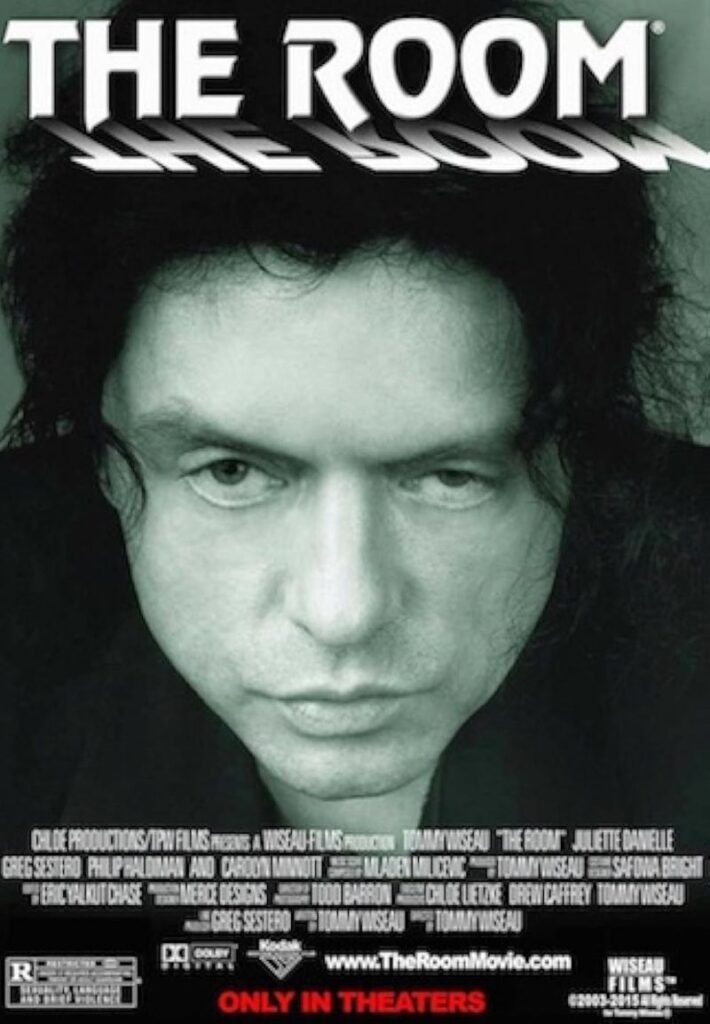
For those fortunate enough not to have seen this film, Google sums it up as follows:
Johnny is a successful banker who lives happily in a San Francisco townhouse with his fiancée, Lisa. One day, inexplicably, she gets bored of him and decides to seduce Johnny’s best friend, Mark. From there, nothing will be the same again.
Inexplicably. That word tells you all you need to know. Nothing in this film makes sense. Not the plot (such as it is). Not the dialogue. Not the costumes. Nothing.
Yet I couldn’t stop thinking about it. I read articles, looked up cast members’ personal websites, watched The Disaster Artist (a movie about making The Room), and contemplated reading the book of the same title by Greg Sestero, the actor who played Mark.
What was I looking for? An explanation? Closure? I couldn’t tell you. All I knew was that this hot mess of a movie was living in my head, rent-free.
As if the universe sensed my predicament, I was presented with an opportunity. Not only was my neighborhood indie theater doing a special screening of The Room, but Greg Sestero would be hosting and participating in an audience Q&A.
As it happened, Peter and I already had plans for that evening. I cancelled them. I had a one-night-only window to get some answers. Nothing was going to stop me from taking it.
In the weeks leading up to the screening, I continued my ruminations. I kept coming back to Lisa, the errant fiancé, and Johnny, the blameless hero. In a film where underdeveloped characters are the norm and motivations as discernible as subatomic particles, this dynamic felt especially problematic.

The relationship itself had all the authenticity of a fake Rolex. The depth of Johnny’s devotion to Lisa is shown through a $20 bouquet of red roses, the gift of a dress (red, of course, and slinky), and his referral to her as “my princess,” along with the cringiest sex I’ve ever witnessed onscreen. Lisa is chided for thinking of leaving him because “he bought you a new car” and has a steady job – as if purchasing power and financial solvency equated entitlement to unquestioning loyalty. Watched from the vantage point of a woman who’s proudly supported herself for nearly a quarter century, the notion smacked of quid pro quo on steroids.
And it pissed me off. First, for the antiquated ideology underpinning the relationship. Second, that the hero’s supposed romantic gestures had nothing to do with the woman herself and everything to do with a script that – literally and figuratively – grants her a space entirely constrained by the male gaze. Does Lisa like roses? Or dresses? Or even the color red?
We as the audience have no idea. And neither, I bet, does Johnny/Tommy.
What’s meant to be, I assume, a portrayal of a loving connection feels about as personal and intimate as junk mail. I’m not sure what meaning the relationship had for either character, aside from offering Johnny an extended interlude of self-deluded cosplay and casual sexism. Lisa doesn’t betray him so much as step outside of the rigidly constructed space he’s allowed her. He doesn’t even give her the humanity of a motivation.
By the film’s end, having watched the cardboard archetypes wend their way towards an inevitable implosion for the better part of two hours, I am exhausted and relieved. I am laughing.
I try to take a generous view. I watch The Disaster Artist to see if there is something admirable about an outsider taking on the Hollywood hegemony. I think long and hard about art and the canon and how the rules around what is considered “good” can be both rigid and arbitrary. I contemplate art for art’s sake.
I’m still pissed. And at last, I figure out why. Why I was so bothered that a crappy film made 20 years had gained a cult following and taken on an improbable afterlife so that its director is seen by some, perhaps, as a visionary iconoclast.
Bullshit, my inner voice cried. The Room is not iconoclastic. The film’s message (if you could call it that) is not original. Bristling with estrogen, I realized that The Room was just a tired variation of the same old chauvinistic shit. In reality, a story that is the very opposite of subversive.
On the night of the screening, I found myself standing in front of Greg Sestero, who seemed normal enough. I debated whether or not to pop the question. Why, Greg? Why was this whole sordid tale expressed as a film instead of a therapy session?
But I didn’t ask. I’d already found my answer. I smiled, asked for his autograph, and thanked him. And with it, at last, I expelled The Room from my system.